
Leopard Tortoise
Stigmochelys pardalis
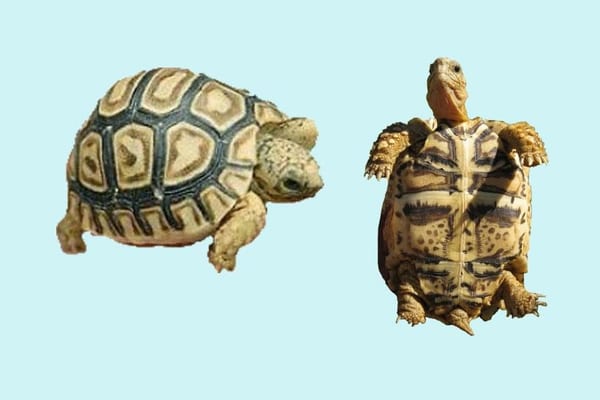
Identification
Its specific name pardalis is from the Latin word pardus meaning "leopard" and refers to the leopard-like spots on the tortoise's shell. The carapace is high and domed, sometimes with pyramid shaped scutes. Juveniles and young adults are attractively marked and the markings on each individual are unique. The skin and background colour are cream to yellow, and the carapace is marked with black blotches, spots or even dashes or stripes. However, in mature adults the markings tend to fade to a slaty, nondescript brown or grey, commonly tinged with the local dust.
Range
This is the most widely distributed tortoise in Southern Africa. It has a wide distribution in sub-Saharan Africa, but is absent from all of West Africa and most of Central Africa. It has been recorded in Botswana, Burundi, DR Congo, Ethiopia, Kenya, Malawi, Mozambique, Namibia, Rwanda, Somalia, South Africa, Sudan, Swaziland, Tanzania, Uganda, Zambia and Zimbabwe.
Diet
As grazers, leopard tortoises feed on a variety of grasses and vegetation. They require a high-fiber diet rich in calcium. In addition to grazing the captive diet may be supplemented a couple times a week with collard greens, turnip greens, mustard greens, dandelion greens and flowers, hibiscus leaves and flowers, grape leaves, escarole, mulberry tree leaves, carrots, zucchini, butternut squash, pumpkin, mushrooms, sweet potato, yellow squash, and bell peppers. Commercial diets may also be included in the diet.
A small portion of the leopard tortoise's diet may include fruits, such as tomatoes, apples, papayas, cantaloupe, honeydew, watermelon, strawberries, raspberries, grapes, mangos and bananas. Fruit should be no more than about 5 percent of the overall diet.
Notes
The leopard tortoise is the second largest tortoise native to Africa. Only the African spurred tortoise is larger. Captive-bred leopard tortoises are generally available. Import of wild caught specimens into the United States was banned in 2000 due to concerns from a tick with heartwater disease found on wild specimens. Before the ban leopard tortoises were commonly imported, and many people currently breed leopard tortoises, however Stigmachelys pardalis pardalis is less common in collections than Stigmachelys pardalis babcocki.
Leopard tortoises are not escape artists and do not climb, burrow, or display the aggressive breeding, biting and ramming that the Mediterranean species do. Multiple males and females may be kept together as they are not territorial like African spurred tortoises.
Interested in an African Tortoise?
Contact us to learn more about availability, pricing, and care requirements.