
Burmese Mountain Tortoise
Manouria emys
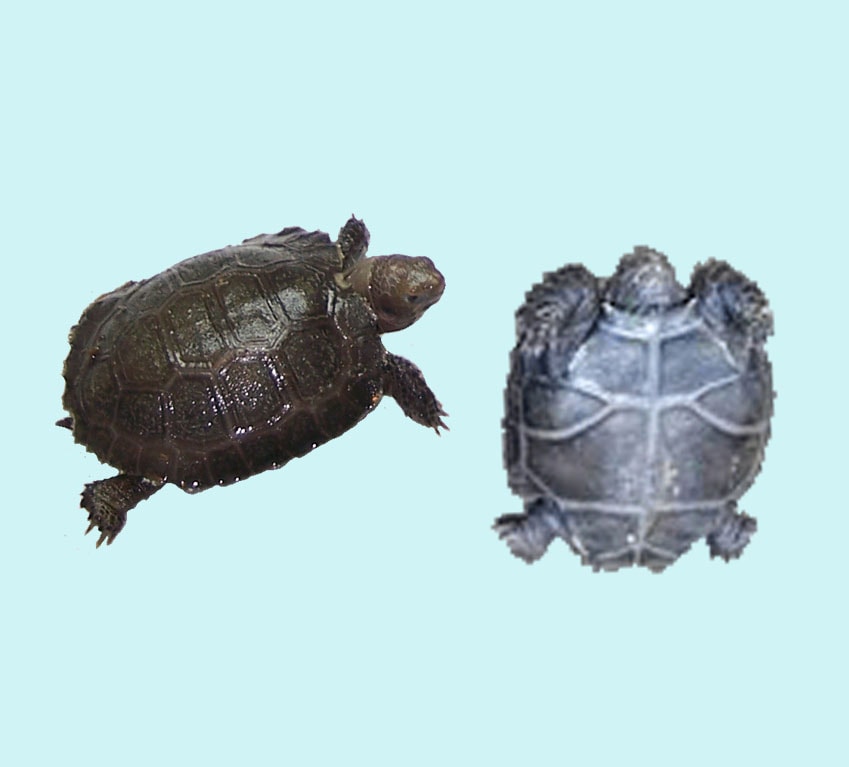
Identification
The Burmese Mountain Tortoise is generally considered the fourth largest land tortoise in the world. It is second in size only to Geochelone sulcata (African Spurred Tortoise) among the mainland tortoises, reaching maximum weights of close to 100 lbs. The phayerei, also called the Black subspecies, is generally considered to be the larger, with emys emys, also called the Brown subspecies, usually only reaching half the size of their relatives. Both have also been called the six-footed (legged) tortoise due to the very large and pointed tubercular scales on the rear thighs. There are generally two ways to tell the two subspecies apart. The first, which works when examining adults, is plastron coloration: M. e. emys has a plastron with yellow coloration compared to the darker coloration of M. e. phayrei. The second, and most accurate way to tell them apart is the scute pattern: M. e. emys has separated pectoral scutes, while those of M. e. phayrei join together at the medial section of the plastron. The scute pattern can be used to identify the subspecies accurately at any age.
Range
In the wild, Burmese Mountain Tortoises are found in Assam, Myanmar (Burma), Thailand, the Malay Peninsula, Sumatra and Borneo.
Diet
Diet is very widely varied, consisting of minimal grasses but lots of clover, plantain, dandelions and other broadleaf weeds. Vegetables, including greens, cactus, cauliflower, yams and squashes are preferred, but fruits and worms are also readily consumed. Protein intake is higher than most grazing herbivores such as Geochelone pardalis (Leopard Tortoises) or G. sulcata, but this is to be expected given the availability of invertebrates and carrion in their natural environment. Most berries and melons are acceptable. Mealworms, earthworms and crickets can be offered as supplemental protein, and a high-quality canned dog food can be used as well, but in moderation. Burmese mountain tortoises are very fast growers. Calcium can be sprinkled on all foods. It is suggested that one use calcium supplemented with vitamin D3 if the animal is being maintained indoors and calcium without D3 if it is outdoors.
Notes
M. emys can be considered the stereotypical tortoise in that they are very slow and deliberate in all their movements and they don't dig long burrows so an outdoor pen's walls need only be slightly taller than the tortoise's shell length. Burmese mountain tortoises are not wall climbers. They are a very fascinating and personable tortoise, if you have the room for them. They are also considered the most ancient genotype of tortoise still living, so in a Burm, you really do have a prehistoric animal.
Burms prefer moderate (as opposed to desert) temperatures of 55°F to 85°F and relatively high humidity between 60% to 100%. Yearlings should not be allowed to reach temps below 65°F or so. Despite the high humidity requirement, airflow is a requirement so a closed or stagnant air cage is not recommended. Hiding spots are preferred, as are rains or mists which will usually stimulate a feeding response. Burms are crepuscular, usually active in the morning and evening, but can be found basking or wandering about during a cool day.
Hatchling tortoises can be very shy. They will usually come out to forage but are otherwise hidden during most of the day. As they age, they often become more comfortable and begin to explore. Adults that are accustomed to their environment become inquisitive and fearless, investigating everything in a slow and methodical way and will often approach to see what you are doing in their yard. If no food is offered, they may well try a tentative bite or nip to see if a finger or toe is tasty. Watch out, they can bite very hard!
Female Burmese mountain tortoises guard their nests after the breeding season, which is very rare in tortoises. These tortoises are CITES II-protected animals, and any pressure put on wild populations will have a negative impact. Captive-born Burmese mountain tortoises are commonly available.
Burmese mountain tortoises can make a great addition to your family as long as you are fully aware of the responsibilities that accompany a tortoise of this size. Their slow, methodical pace in life is something to admire.
Interested in an Asian Tortoise?
Contact us to learn more about availability, pricing, and care requirements.