
Greek Tortoise
Testudo graeca
Identification
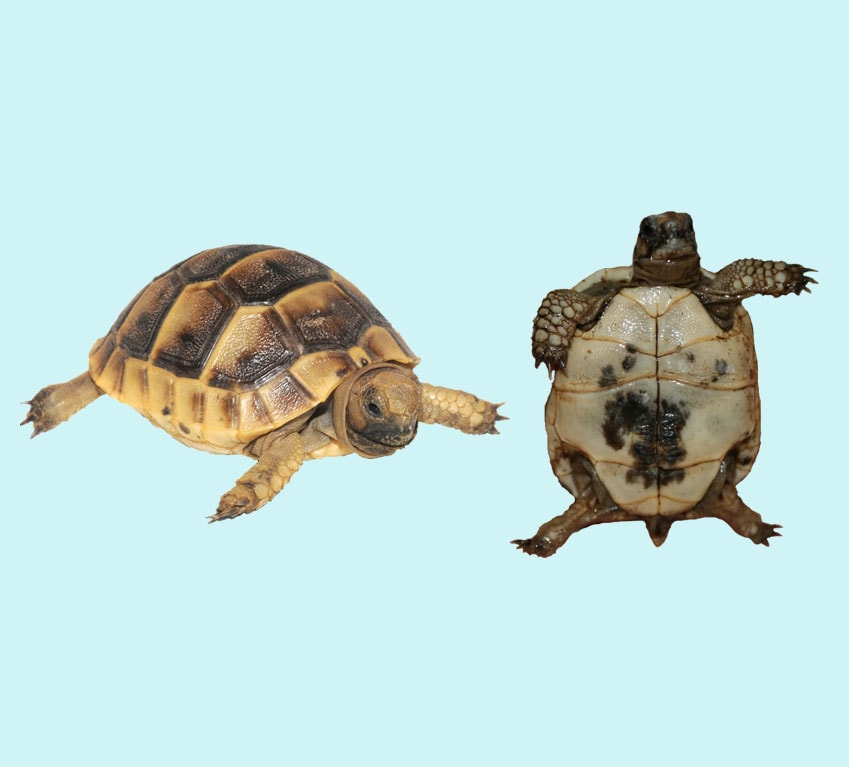
The Greek tortoise is also known as the spur-thighed tortoise for the large conical tubercle it has on each thigh. One to three raised scales, spurs or tubercles are located on either side of the tail, on each thigh. Flecks, borders, rays and spots on the shell produce a pattern reminiscent of a Greek mosaic, hence the common name. The division of spur-thighed tortoises into subspecies is difficult and confusing. Given the huge range over three continents, the various terrains, climates, and biotopes have produced a huge number of varieties, with new subspecies constantly being discovered. Currently, at least 20 subspecies are published. The differences in form are primarily in size and weight, as well as coloration, which ranges from dark brown to bright yellow, and the types of flecks, ranging from solid colors to many spots. Also, the bending-up of the edges of the carapace ranges from minimal to pronounced. So as not to become lost in the number of subspecies, recently a few tortoises previously classified as Testudo graeca have been assigned to different species, or even different genera. The genetic richness of Testudo graeca is also shown in their crossbreeding. Tortoises of different form groups often mate, producing offspring with widely differing shapes and color. Perhaps the best means of identification for the future is simply the place of origin.
Range
The spur-thighed tortoise's habitat is North Africa, southern Europe, and southwest Asia. It is prevalent in the Black Sea coast of the Caucasus (from Russia Anapa to Abkhazia Sukhumi to the south), as well as in Georgia, Armenia, Azerbaijan, France and England.
Diet
Greek tortoises spend much of their time grazing on edible landscape. For this reason, it is an excellent and healthy idea to offer weeds such as dandelion, clover, plantain, hawksbit, cat's ear, wild strawberry and thistle. When these items are not available (often during the winter months), they can be replaced by dried, bagged organic herbs. These can be found online.
Store-bought greens such as collard, mustard, kale and turnip can be offered sparingly. Commercial diets such as Mazuri Tortoise Diet are excellent for helping Greek tortoises to maintain good weight, but again, should be offered only in moderation. Calcium supplements in the form of cuttlebone are wonderful additions to their diet; the tortoises will gladly nibble on them.
Many Greek tortoises originate from extremely arid habitats while others are found in more temperate locations. Regardless of their origin, all Greek tortoises need to stay hydrated. A shallow water dish should be available at all times for drinking and soaking, and it should be cleaned/changed frequently. Tortoises defecate in their water, so keeping the supply clean is a must. Greek tortoises also appreciate an occasional misting of their environment, which prompts them to empty their bowels and drink.
Notes
Males differ from females in six main points. Firstly, they are generally smaller. Their tails are longer and taper to a point evenly, and the cloacal opening is farther from the base of the tail. The underside is somewhat curved, while females have a flat shell on the underside. The rear portion of a male's carapace is wider than it is long. Finally, the posterior plates of the carapace often flange outward.
North African populations mate from April to May, and again in autumn, but this varies greatly according to locality and altitude. Nesting occurs in May and June and more than one clutch may be produced each season. Eurasian and Middle Eastern tortoises generally nest in May or June, but nesting has been observed from April to July. Clutches typically contain between one and seven eggs (average three to four), but large Algerian tortoises (T. g. whitei) lay clutches of as many as 12 to 14 eggs. Depending on their location, this species may hibernate during winter, and aestivate throughout summer.
Similar to most turtles and tortoises, Greek tortoises do not like to be held. They should be picked up only when absolutely necessary, such as prior to being soaked, cleaning of the enclosure and health checks. While they tend to become very responsive to their keepers and will approach for food, they should not be over-handled by any means. Greek tortoises are easy-going, friendly and interactive, but like all reptiles, they should never be overly stressed.
Classified as Vulnerable (VU) on the IUCN Red List and listed on Appendix II of CITES. There are several recognised subspecies, although taxonomic classification continues to be hotly debated. The IUCN only lists one subspecies, T. g. nikolskii, which is classified as Critically Endangered (CR).
Interested in a Mediterranean Tortoise?
Contact us to learn more about availability, pricing, and care requirements.