
Hermann's Tortoise
Testudo hermanni
Identification
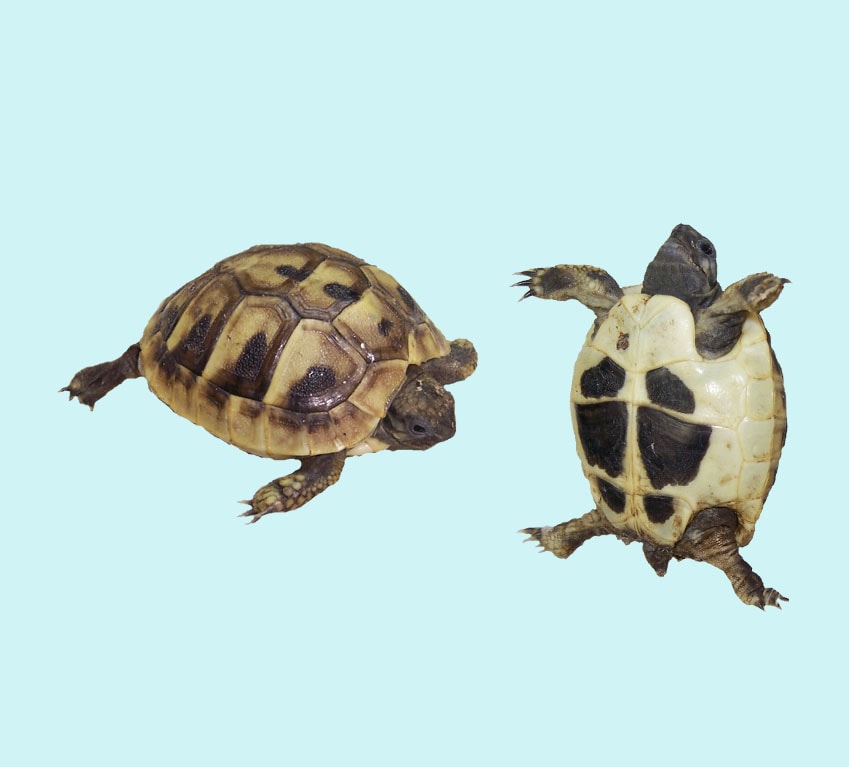
The head is brown to black, with fine scales. The fore legs similarly possess fine scales. The limbs generally have five claws, which are darkly colored at their base. The hind legs are noticeably thicker than the fore legs, almost plump. The particularly strong tail ends in a spike, which may be very large in older male specimens. Females have noticeably smaller tail spikes, which are slightly bent toward the body. The Western race, Testudo hermanni hermanni, is more brightly colored than the Eastern, Testudo hermanni boettgeri race, with a more domed carapace. Western Hermann tortoises usually (but not always) have a yellow spot on the head behind each eye. The most reliable distinguishing mark is the two dark bands running along the length of the plastron (i.e. the underbelly), which the Eastern race do not have. The Eastern race's shell is not as highly domed as the Western race and they grow a bit bigger, to about 8". The markings show more individual variation than in Western Hermanns, with less color contrast. The yellow spot behind the eye is rare (though some have it!). Most distinctively, the underbelly of this beast has more broken, faded marking than the Western subspecies.
Range
The Western race, Testudo hermanni hermanni, is native to northern Spain, southern France, northwest Italy and some of the islands in the western Mediterranean. The Eastern race, Testudo hermanni boettgeri, is native to southern Italy, Albania, Greece, Yugoslavia and the Balkans.
Diet
Hermann's tortoises determine which plants to eat by the sense of smell. The basis of your Hermann tortoise's diet should be green leafy plants: weeds, flowers, clover, wild lupine, grass, hibiscus, endive, romaine, dandelion, charlock, watercress, chickweed, groundsel, plantain leaves, sow thistle and vetches and the leaves of plants and bushes like buddleja, ice plant, lilac, rose and bramble. It is alright if they pick up a snail or slug in the garden every now and then, but you should never feed them meat, and certainly never dog or cat food, as some misinformed tortoise owners do. Give the tortoise as much as it can eat in thirty minutes, about five times a week.
Notes
Hermann tortoises (Testudo hermanni) are one of the most popular species of tortoise to keep as pets and it's easy to see why. They have a level of individual personality that is rare in reptiles, and they can be very charming and funny. They develop a bond of companionship with their owner, and you will get to know their individual quirks, likes and dislikes. They live about 75 years, which gives us something in common!
Hermann tortoises are particularly frisky and active. They like to burrow and they like to climb, so you need to secure their habitat to stop them busting out and getting into mischief. If you're keeping them outdoors, make sure they can't tunnel out.
Some species of tortoise do not hibernate at all, while others won't hibernate when kept in domestic conditions where plenty of food and water is available. Hermann's tortoises are unusual in that they always hibernate no matter the conditions. As a tortoise keeper, you need to be aware of this and prepare a spot to let your animal hibernate.
Interested in a Mediterranean Tortoise?
Contact us to learn more about availability, pricing, and care requirements.