
Marginated Tortoise
Testudo marginata
Identification
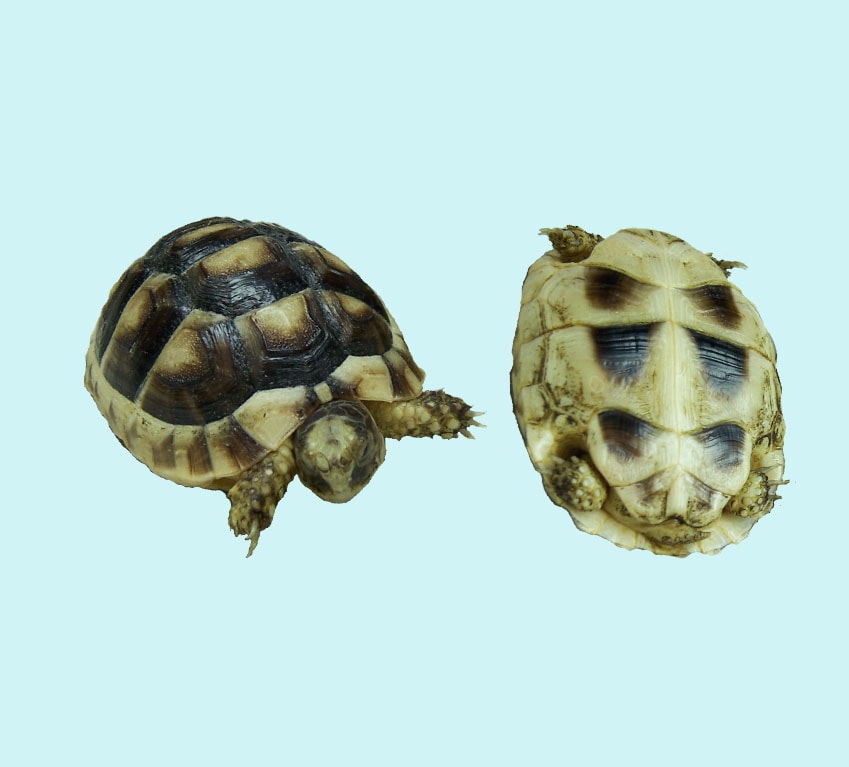
The Marginated Tortoise is the largest European tortoise, reaching a weight of up to 11 lb and a length of 14 in. Its shell is oblong and has a notable thickness around the middle of the body. The posterior end of the shell has a saw-like formation, flanged outward like a bell. The carapaces of adult specimens are almost completely black, with yellow highlights. The front sides of the limbs are covered with large scales. The tail is notable for a lengthwise marking and for an undivided carapace over the tail. The male has a longer tail, which is thicker at the base than the female's. The underside is more strongly indented. Males are also often larger than the females. Testudo marginata is also closely related to the Greek or spur-thighed tortoise (Testudo graeca). Both have very similar bodily characteristics — oblong carapaces, large scales on the front legs, large coverings for the head and cone-like scales on the upper thighs, undivided tail coverings, moveable stomach plates, and lack of tail spikes. The marginated tortoise is a unique looking tortoise because of its extremely flared marginal scutes from which it gets its name. The males' marginal scutes are usually much more flared than on the female.
Range
The natural range of the marginated tortoise is southern Greece, from the Peloponnesus to Mount Olympus. They are also found in isolated zones of the Balkans and Italy, and northeastern Sardinia.
Diet
Marginated tortoises are herbivorous, their diets consisting primarily of plants from their native Mediterranean region. These tortoises are opportunistic feeders in that they will take the usual dark leafy greens, weeds and some grasses. They are not known to be very active grazers. Marginateds are also known to consume insects, snails and carrion. In captivity they can be fed dark leafy greens, fibrous fruits such as pears and apples in addition to various berries. The main idea is to feed as varied as possible.
Notes
The marginated tortoise lives in more mountainous regions than Hermann's tortoise. It can be found in elevations as high as 1,600 m (5,200 ft). The black color of the carapace is helpful for survival in this environment, as it allows the tortoise to absorb a great deal of heat in a short time, helping it maintain its body temperature. Early in the morning, marginated tortoises bask in the sun to raise their body temperature, and then search for food. After feeding, the tortoises return to their shelters in the hot midday hours, leaving them again in the late afternoon.
Marginated tortoises are fairly calm and relaxed, although they can be somewhat territorial in the wild. They have a controlled temper and are generally slow to anger. If they are not given the proper diet in captivity, however, they will become rather aggressive and might mistakenly attack if they feel threatened.
Wild caught specimens of this tortoise used to be a commonly imported tortoise but is now not imported at all as wild caught tortoises because it is protected throughout its range. Because of successful breeding in captivity it is now becoming more commonly available as captive born tortoises.
Marginated tortoises are very cold tolerant and should be maintained at a temperature range of 75 to 90 degrees Fahrenheit at the basking site. If temperatures fall below this they will be inclined to hibernate which they do in the wild when the seasons dictate it.
Interested in a Mediterranean Tortoise?
Contact us to learn more about availability, pricing, and care requirements.