
Cherryhead Tortoise
Geochelone carbonaria
Beginner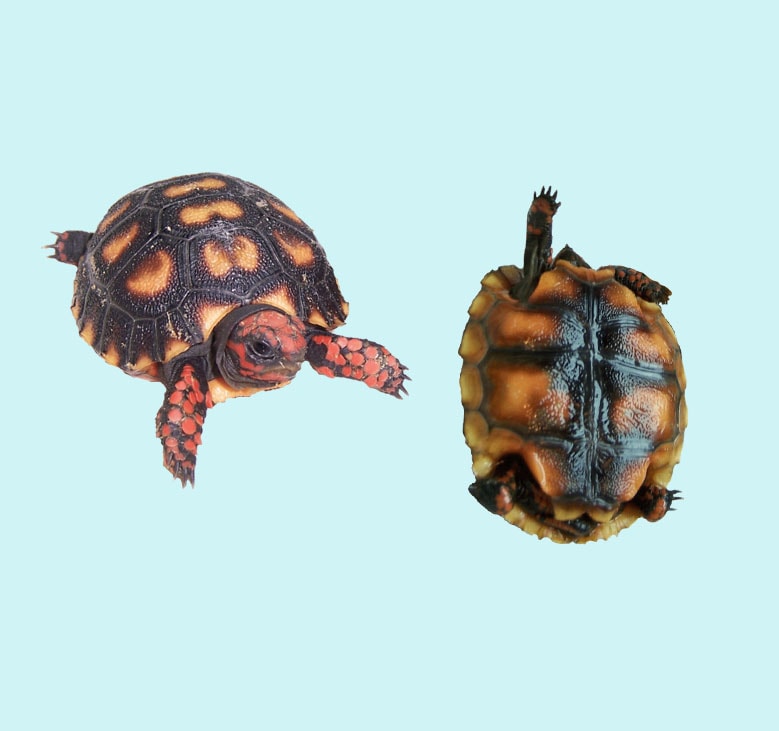
Identification
Cherry Head Red Footed Tortoises are a very pretty, slightly smaller version of the classic Red Footed Tortoise. The beautiful unique color pattern of a cherry head red foot tortoise makes them easily distinguished from all other types of tortoises. The head and legs are a vivid bright red or a red and orange color blend. The shell has a pattern mixture of solid bright orange or golden orange with dividing lines of dark brown or a light tan color. Some are born with lighter shells, and others with darker shells. All Cherry Heads grow up to have bright red/orange heads and legs. A cherry head red foot tortoise is considered small to medium in size and grows to an average length of nine to twelve inches long.
Range
Cherry Heads are a bit of a mystery. No one seems to know the exact range or preferred habitat, if it is a subspecies or a different species or just a local variant, etc. They seem to come from the central-eastern part of Brazil — Bahia (near towns like Lencois and Baiaxa Grande), and possibly Goias, Mato Grosso, etc.
Diet
A cherry head red foot tortoise requires a diet that is high in fiber and calcium and low in fat and protein. Store bought tortoise food may be provided but must be supplemented daily with natural food. Provide a wide variety of natural food until favorites are discovered. A large amount of the natural food should consist of plant products including carrots, collard greens, cucumbers, green leaf lettuce, kale, spinach, squash, sweet potatoes, romaine lettuce and tomatoes. A small amount of natural food should consist of animal foods including butter worms, earthworms, mealworms, super worms, and wax worms and an equally small amount of fruit consisting of bananas, grapes, mangos, peaches and strawberries.
Notes
In 1984, the Blue Ribbon Pet Farm in Miami received a shipment of 3,500 unusually colored red-footeds from South America, along with a large batch of chaco tortoises (Chelonoidis chilensis). The brilliant red colors were so remarkable that Scott Hearsey listed them as 'Cherry-head Red-foots' on the next price list. 'Cherry-head' was just a way to describe the distinctive colors of the batch. They had no way of knowing that these animals would turn out to be such a phenomenon!
They are quite intelligent, have good memory, and learn rapidly where and when food is available, and where shelter and basking is to be found. They have a strong sense of smell, and their sense of touch includes even the slightest contact with their shell.
Cherry Heads are a good choice for the keeper since they seem to be a bit smaller and hardier than the more common Northern group. The fact that they are prettier as well is just a nice bonus!
The things that make a Cherry Head different from a typical Northeastern red-footed include: a mostly dark plastron which often lacks a defined pattern; the carapace is more likely to show mottling (white spaces developing between scutes as they grow) than Northerns; an enlarged, colorful scale on the inside of the front 'elbows'; the nose is usually brightly colored and slightly bulbous compared to a Northern — this is the 'Rudolph Sign'; the scales on the head and legs are the same color — brick red to cherry red, oranges, some yellows, even pinkish on occasion; and typical sizes are 23cm/9in for males and 25cm/10in for females compared to about 30cm/12in for Northeasterns, although 'giant' individuals over 35cm/14in are often found.
Gender differences include: adult male Cherry Heads do not show the 'wasp waist' shell constriction and often do not have as deep a plastron indentation; some adult males show a flaring of the rear marginals; large female Cherry Heads often develop a bit of a 'bump' on the last vertebral scute; they appear to reach maturity earlier and at a smaller size than Northeasterns — 15cm/6in and about 4–6 years old compared to 20cm/8in and 6–8 years old; females do not generally lay eggs until about 24cm/9.5in; and male Cherry Heads are generally smaller than same-age females, unlike Northeasterns.
Some observations by many keepers: Cherry Heads often slow down in winter for several weeks, eating less even at usual temps and humidity — most keepers just let them ride through this. Cacti appear to be a preferred food in the wild and they seem to like it in captivity. Adult males are known to fight — keep them separated or in a very large habitat with lots of obstacles. Foods rich in beta carotene (carrots, yellow squash, yams, collards, spinach, kale) may help brighten colors. They do not seem to drink as much as other red-footeds but water should always be available. They tend to be active at cooler temps than other red-footeds as long as it is sunny, but may hide during cloudy periods. They are more tolerant of temperature and humidity extremes, but young tortoises should be kept warm and humid like other red-footeds.
A striking regional variant of the Red-footed Tortoise, prized for their vivid red-orange head coloration. Highly sought after in the pet trade.
Interested in a South American Tortoise?
Contact us to learn more about availability, pricing, and care requirements.