
Galapagos Tortoise
Chelonoidis nigra
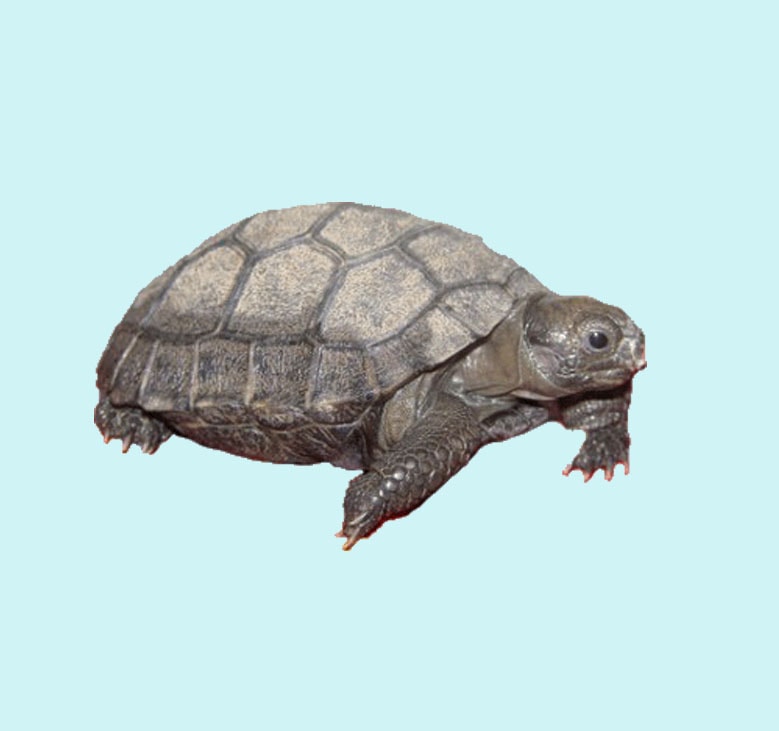
Identification
The Galápagos tortoise or Galápagos giant tortoise (Chelonoidis nigra) is the largest living species of tortoise. Modern Galápagos tortoises can weigh up to 900 lbs. Today, giant tortoises exist only on two remote archipelagos: the Galápagos, 620 miles due west of Ecuador, and Aldabra in the Indian Ocean, 430 miles east of Tanzania. Shell size and shape vary between populations. On islands with humid highlands, the tortoises are larger, with domed shells and short necks; on islands with dry lowlands, the tortoises are smaller, with 'saddleback' shells and long necks. Charles Darwin's observations of these differences on the second voyage of the Beagle in 1835 contributed to the development of his theory of evolution.
Range
The tortoise is native to seven of the Galápagos Islands, a volcanic archipelago about 620 miles west of the Ecuadorian mainland. Spanish explorers, who discovered the islands in the 16th century, named them after the Spanish galápago, meaning tortoise.
Diet
The tortoises are herbivores that consume a diet of cacti, grasses, leaves, lichens, and berries. They have been documented feeding on Hippomane mancinella ('poison apple'), the endemic guava Psidium galapageium, the water fern Azolla microphylla, and the bromeliad Tillandsia insularis. Tortoises acquire most of their moisture from the dew and sap in vegetation, particularly the Opuntia cactus, and can survive longer than 6 months without water. They can endure up to a year when deprived of all food and water, surviving by breaking down their body fat to produce water as a byproduct.
Notes
With lifespans in the wild of over 100 years, the Galápagos tortoise is one of the longest-lived vertebrates. A captive individual lived at least 170 years.
The tortoises are ectothermic (cold-blooded), so they bask for 1–2 hours after dawn to absorb the sun's heat through their dark shells before actively foraging for 8–9 hours a day. They travel mostly in the early morning or late afternoon between resting and grazing areas and have been observed to walk at a speed of 0.2 mph.
On the larger and more humid islands, the tortoises seasonally migrate between low elevations — which become grassy plains in the wet season — and meadowed areas of higher elevation up to 2,000 ft in the dry season. The same routes have been used for many generations, creating well-defined paths through the undergrowth known as 'tortoise highways'. On these wetter islands, the domed tortoises are gregarious and often found in large herds, in contrast to the more solitary and territorial disposition of the saddleback tortoises.
Tortoises sometimes rest in mud wallows or rain-formed pools, which may serve as both a thermoregulatory response during cool nights and a protection from parasites such as mosquitoes and ticks. Some tortoises shelter at night under overhanging rocks; others sleep in a snug depression in the earth or brush called a 'pallet'.
Tortoise numbers declined from over 250,000 in the 16th century to a low of around 3,000 in the 1970s. This decline was caused by overexploitation for meat and oil, habitat clearance for agriculture, and introduction of non-native animals such as rats, goats, and pigs. Ten subspecies of the original 15 survive in the wild. The most famous individual, nicknamed Lonesome George — the last known member of the C. n. abingdonii subspecies — died in June 2012. Conservation efforts have resulted in thousands of captive-bred juveniles being released onto their ancestral home islands, and the total population is estimated to have exceeded 19,000 at the start of the 21st century. Despite this rebound, the species is classified as 'vulnerable' by the IUCN and is protected under CITES Appendix I.
The iconic giant tortoise of the Galápagos Islands — the largest living tortoise species on Earth and one of the longest-lived vertebrates.
Interested in a South American Tortoise?
Contact us to learn more about availability, pricing, and care requirements.