
Yellowfoot Tortoise
Geochelone denticulata
Intermediate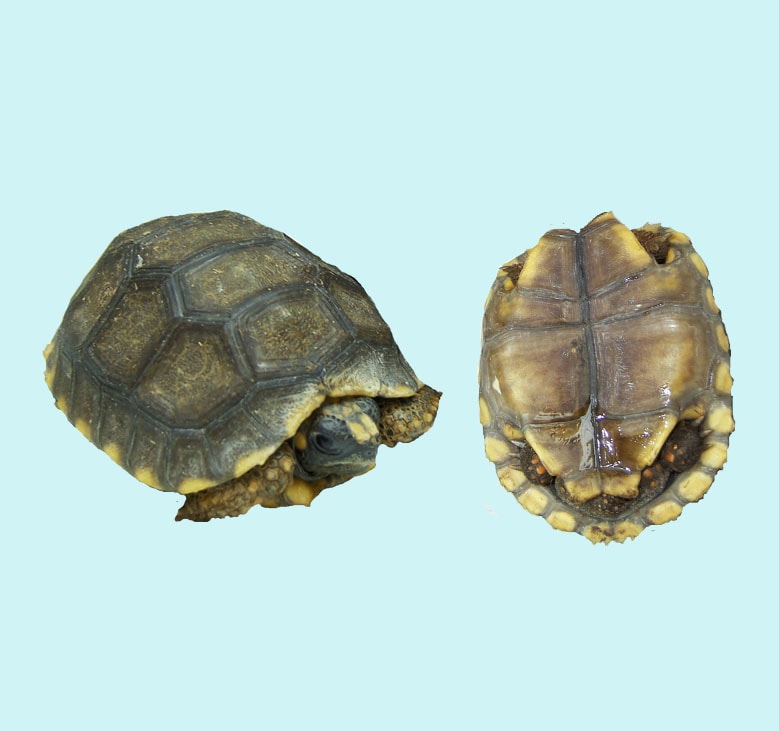
Identification
The Yellow-footed tortoise is very similar to the red-footed tortoise (Chelonoidis carbonaria). They are mostly brown to dark coffee carapace with light patches and have a dark head and limbs with scales in some shade of yellow to yellow-orange. The growth rings on the scutes are generally smoother than the red-footed. The plastron is dark with paler centers to the scutes. The yellow-foot is the 3rd largest mainland tortoise. They typically grow 14 to 20+ inches in about ten years. Older adults can range 16–37 inches and 20–200 pounds. The largest recorded specimen was 37 inches in length and almost a couple hundred pounds.
Range
Primarily found on the forest floor in the Amazon Basin of Brazil, Peru, Ecuador, and Northern Bolivia. They are also found in Guyana, Suriname, and Colombia. Yellowfoot tortoises are found in deeper forest regions whereas the red-foots are found in more outlined forest savannas.
Diet
In the wild, Yellow-foots consume moss, broad leaf plants, carrion, mushrooms, some grasses but mainly large leafed plants and carrion.
Notes
The yellow-foot tortoise is known to like less light in captivity as it is used to having the sunlight filter through the various canopies of the Amazon Rain Forest in South America. Yellow-foots are very good swimmers and climbers. When the rainy season is in full swing these tortoises will take no obstacle in swimming through basin deltas and rivers to breed or forage for food.
It is unclear if yellow-footeds have a distinct mating season or not. Yellow-footeds court by sniffing the cloacal region and doing species-specific head movements side to side. A willing female responds with similar motions, and female yellow-footeds also release a strong scent. Similar motions are also used to determine dominance between males. Ramming, chasing, and biting are also often involved, especially with the rather aggressive yellow-foots. Yellow-foots vocalize when breeding with a clucking sound like a chicken.
For nests, Yellow-foots most often use piles of leaf litter, but sometimes dig, use half digging and half litter, or just leave the eggs on the surface. A typical yellow-foot clutch is 3–10 eggs that are more spherical and a bit larger than Red-foots.
The conservation status of the Yellow-foot is CITES Appendix II. These are endangered and controlled by CITES for any international trade. Habitat destruction, consumption, and over exportation are the main threats to this species.
Also called 'yellow-foot', 'yellow-legged', 'forest tortoise', or the South American or Brazilian 'giant tortoise'. Local names are generally similar to the red-footed tortoise.
Interested in a South American Tortoise?
Contact us to learn more about availability, pricing, and care requirements.