
Chicken Turtle
Deirochelys reticularia
Intermediate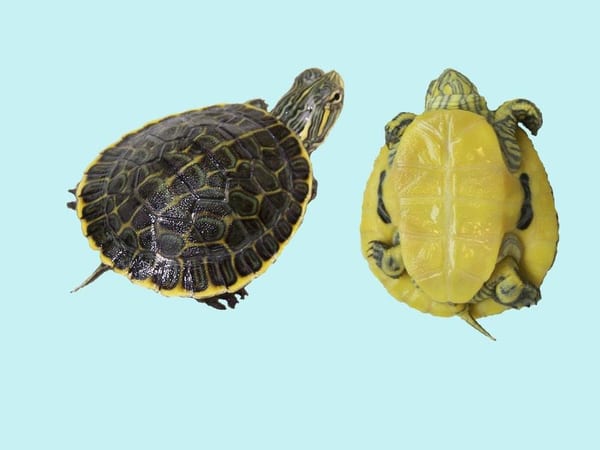
Identification
The chicken turtle is similar in appearance to the Peninsula Cooter turtle, but has an unusually long, striped neck that is close to the length of its shell, with a yellow stripe on both the forelegs and rear legs. It has a distinguishable net-like pattern on its carapace. The carapace is pear-shaped, and is an olive to dark brown. Females are usually larger than the males, and males have a longer, thicker tail. Males also have longer front claws. At birth, chicken turtles are one inch in diameter, and adults reach from 10.2–25.4 cm. The carapace has a brown to grey base color with a distinctive reticulate pattern. The plastron tends toward plain yellow. There's a single broad yellow stripe down the front of the fore-legs. They are famous for having very long necks and carry the nickname 'American snake neck'.
Range
The 3 subspecies are distributed over the South-Eastern and South-Central United States from Florida and the low to mid-East Coast westward to East Texas and Southeastern Oklahoma. The Western Chicken Turtle is found mostly west of the Mississippi River. The Eastern Chicken Turtle occurs east of the Mississippi River and runs east through Northern Florida and midway up the East Coast. The Florida subspecies is confined to roughly the lower two-thirds of Florida. There are three distinct subspecies: Eastern chicken turtle (Deirochelys reticularia reticularia), Florida chicken turtle (Deirochelys reticularia chrysea), and Western chicken turtle (Deirochelys reticularia miaria).
Diet
Chicken turtles are omnivorous, eating crayfish, fish, fruits, insects, invertebrates, frogs, tadpoles and plants. During the first year of their life they are almost completely carnivorous. Chicken turtles use their well-developed hyoid apparatus to create suction that pulls food items into their throat, which is very unusual. Hatchlings may be offered a moderate protein diet once daily, graduating to every other day after 6 to 12 months. Romaine lettuce, Anacharis, Water Hyacinth and other safe edible aquatic plants should be offered often to encourage low-protein intake. Choose a good brand name commercial food (i.e.: Mazuri, ReptoMin, etc.) and augment with live food offerings (crayfish, earthworm, cricket, etc.). Include small crayfish or shrimp and Hikari vitamin-enriched frozen bloodworms.
Notes
Chicken turtles are regularly encountered on land, migrating between aquatic habitats or seeking areas to burrow into the soil and escape dry conditions. They are social, spending much of their time basking on logs and rocks and swim in small groups. Chicken turtles hibernate in the soft mud, but only in the northern part of their range. They are known to be timid and if caught they generally will bite very easily.
Chicken turtles are semi-aquatic turtles found both in water and on land. They prefer quiet still bodies of water: shallow ponds and lakes, ditches, marshes, cypress swamps, and Carolina Bays. They prefer water with dense vegetation and soft substrate and have been found at depths of a few centimeters to more than 2 m.
Chicken turtles nest in either fall or winter — different from most other North American turtles. In South Carolina there are two egg-laying seasons: winter to early spring (February to May) and fall to early winter (August to November). Females lay 2 to 19 clutches of eggs. Incubation temperature influences the sex of the embryos, with a 25°C incubation temperature resulting in all males.
One in every fifty turns out to be a High Colored Florida Chicken Turtle. One of the two North American snake necks (Blanding's being the other), chicken turtles use their long necks and specialized throats and mouths to suck in or snap up food. Juveniles are excellent tank turtles, and adults do well in outdoor ponds in summer months, or year round in warmer climates. Many adults adjust to captivity slowly, and acquiring established individuals is the key to success.
Interested in These Species?
Contact us to learn more about availability, pricing, and care requirements for any of our other pond turtle species.